Nobody Calls Medical Billing Fun
A friend of ours in the medical field tried the CBCS course last month. We expected polite feedback — the kind where someone says "this is cool" and never logs in again. Instead she told us Ari was kind of fun. Fun. Nobody calls studying for medical billing certification fun. But she meant it. She said she'd catch herself going back for another topic just to see how Ari would explain it.
That word reminded us why we started this.
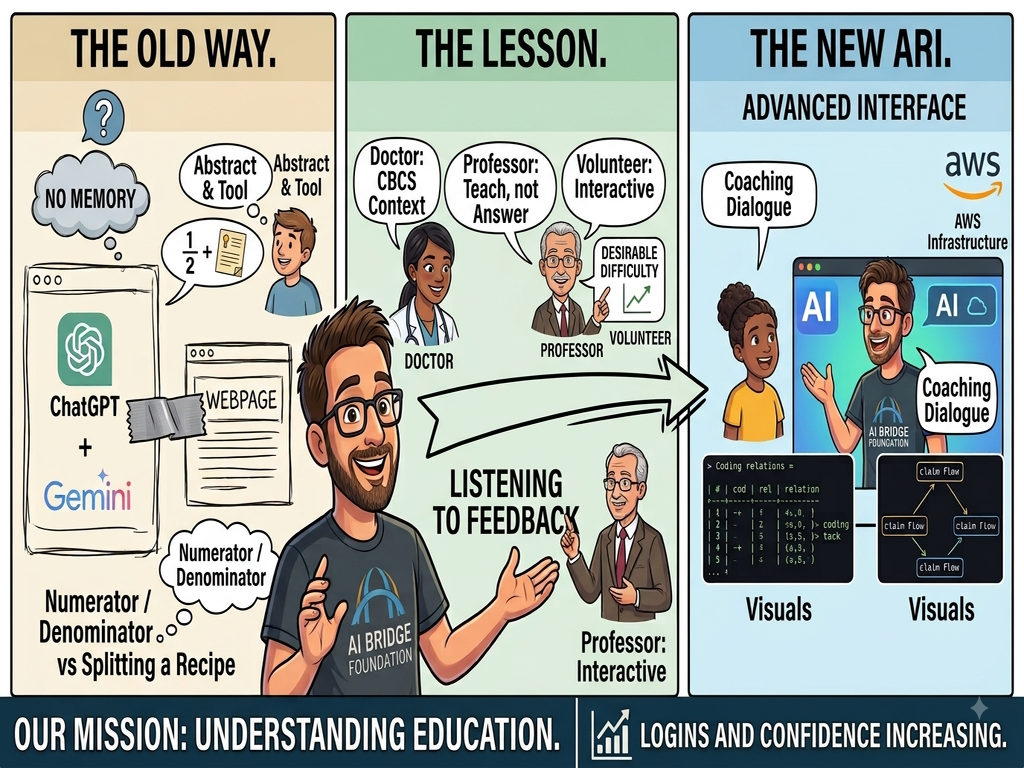
When we first built this website, we didn't have AWS grants or adaptive learning systems. We had a pinned AI tutor — basically ChatGPT and Gemini duct-taped to a webpage. People could ask questions and get answers. But it wasn't teaching. It was just responding. There's a difference, and it took us a while to understand how big that difference is.
The early version had no memory of what you'd already learned. If you asked the same question on Monday and Thursday, it gave you the same answer both times. It was a tool, not a tutor.
What changed was people telling us the truth. A volunteer said the GED math explanations were too abstract — "nobody learning fractions for the first time wants to hear about numerators and denominators, they want to know how to split a recipe in half." A user in our teen program said Ari felt like a textbook that could talk. Our board member — a college professor in education — walked us through how people actually learn. Desirable difficulty. Retrieval practice. The protégé effect. These weren't just theories. They were design instructions telling us exactly what Ari was doing wrong.
So we rebuilt the thinking underneath. Ari now tracks what you've struggled with. Ari doesn't just answer — Ari asks you to explain back, to apply, to connect. When you get something wrong, Ari asks what you were thinking instead of just correcting you. That shift — from correcting to coaching — changed everything.
Some things surprised us. Users told us Ari's text-art visualizations actually helped — simple ASCII tables showing how billing codes relate, rough diagrams of how a claim flows from provider to payer. Not perfect, but enough to give visual learners something to hold onto beyond a wall of text.
One of our volunteers tried the AI Basics course after coming from Anthropic Academy — the official training from the company that builds Claude. Found it one-dimensional. She even asked Claude to build her a curriculum and it only went so far. Then she tried ours. "I've learned more in just the few lessons on your platform than anywhere else, no joke," she wrote. "It has the interactivity that Anthropic Academy lacks."
A free tool from a tiny nonprofit, preferred over training built by a billion-dollar company. Because ours feels like a conversation, not a slideshow.
And the deeper we got into making Ari teach well, the more we learned about what AI can't do. It over-explains. It fills silence with words. It gives you the answer before you've had a chance to think. It hallucinates — confidently tells a student something that's just wrong. It's poorly calibrated — treats a simple question with the same weight as a complex one. And it's sycophantic — tells you you're doing great when you're not, because the model wants to be agreeable more than it wants to be honest. Every one of those instincts is dangerous for education. A tutor that lies to be nice is worse than no tutor at all. We fight those tendencies every day — rewriting prompts, adding guardrails, testing edge cases — because our students deserve answers they can trust.
We're on AWS now. Real budget, real infrastructure. The pinned tutor days feel far away. But the grant money isn't what made us better. Listening is what made us better.
Our logins have grown significantly this year. People are coming back — not visiting, returning. A teenager working through AI fundamentals. An adult studying for her CBCS. A career changer doing certification prep at midnight. We can see it in the data — how their responses evolve, how their confidence shifts over time.
We're not done. Every week we find something Ari handles poorly. Our professor keeps us honest. The feedback keeps us honest. The gap between what Ari is and what Ari could be is still enormous.
But we know now what we didn't know at the start: the technology was never the hard part. Understanding education was. We're still learning that. Every single day.
Every message from a user, every piece of honest feedback — it humbles us. It reminds us that someone out there is counting on this to work. Someone studying after a long shift, trying to learn one new thing that might lead to a better job, a better paycheck, a better life for their family. That's not abstract to us. That's the person on the other side of every prompt we write and every guardrail we build. We just want to do right by them.