The AI Study Habit That Makes You Fail the Test
Here is a finding that should stop you cold if you study with ChatGPT. Researchers at Wharton and the University of Pennsylvania ran an experiment with nearly 1,000 high school math students. One group got a plain ChatGPT-style assistant to help them practice. During practice, that group crushed it — they solved 48% more problems correctly than students with no AI at all. Then the researchers took the AI away and gave everyone a closed-book test on the same material.
The students who had practiced with the answer-giving AI scored 17% worse than the students who never touched it.
Not worse than they hoped. Worse than the people who studied the old, hard way with a textbook and their own notes. The tool that made practice feel easy quietly made them worse at the actual thing they were practicing for.
The trap is the answer button, not the tool
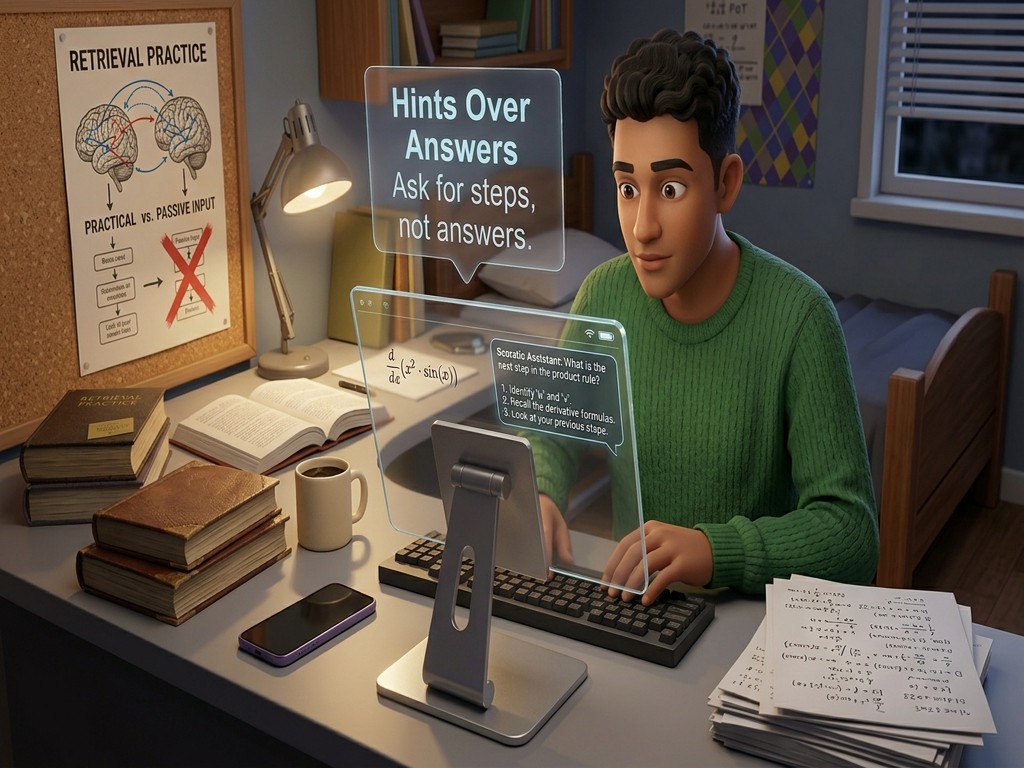
It would be easy to read that and swear off AI for studying. That's the wrong lesson, and the same study proves it. A third group used a version with guardrails — built to give hints and ask guiding questions instead of handing over the answer. They didn't crash on the test. They scored about the same as the students who used no AI at all, and got there with a lot less pain.
Same technology, opposite outcomes. The only thing that changed was whether the AI handed over the answer or made the student work for it.
This lines up with what other researchers keep finding. In one college AI course, students who asked ChatGPT to explain concepts did better on exams; the ones who used it to shortcut assignments did worse. The pattern holds every time. When the AI does the thinking, you don't — and the test only measures what ended up in your head.
Why "getting the answer" feels like learning but isn't
Here is the sneaky part. Reading a clear explanation feels like understanding. The answer makes sense, every step is logical, you nod along, and your brain files it under "got it." But recognizing that something makes sense is not the same as being able to produce it yourself with the page blank and the clock running.
Learning happens when your brain struggles to pull something out, not when it comfortably takes something in. That struggle — trying, getting stuck, being a little wrong — builds a memory you can actually reach on test day. When you paste a question into ChatGPT and read the answer, you skip the struggle entirely. It feels productive. It's the opposite. In the Wharton study, the students using the answer-giving AI were also the most overconfident about how much they'd learned. They felt ready. They weren't.
The one change that flips it
You don't need a special app or a paid tier to fix this. You need to change one instruction. Stop asking the AI for answers and start ordering it to withhold them. (The one exception: if you're brand new to a topic with nothing to reason from yet, ask for a single worked example first — then switch the answers back off the moment you can take a swing yourself.)
Try the exact study session that works. First, attempt the problem yourself — badly is fine. Then tell the AI plainly: "Don't give me the answer. I'm going to try to explain this, and I want you to tell me where my reasoning is wrong." Free ChatGPT does this. Claude's free tier does this. ChatGPT's newer study mode is built specifically to do this. Then you talk. You explain the concept back in your own clumsy words, the AI catches the gap, you try again. Only after you've genuinely wrestled with it do you let it quiz you — and you tell it to keep the answers hidden until you've committed to one.
Three prompts carry almost all the weight. "Explain this like I'm twelve, then ask me a question about it." "I'm going to explain this back to you — tell me what I got wrong, but don't give me the answer." "Quiz me and don't show the answer until I've tried."
Notice what those have in common: every one of them keeps you doing the work. The AI becomes the thing that catches your mistakes, not the thing that prevents you from making them. Mistakes, made while you're paying attention, are where the learning is.
Here's the catch nobody admits: willpower is not a study plan. When the deadline is tomorrow and you're exhausted, "just tell me the answer" wins — which is exactly why guided tools like ChatGPT's study mode, or our own tutor Ari, build the guardrail in and coach with questions instead of solutions, so they hold the line on the night your discipline won't.
How to know it's working
The check is simple and a little uncomfortable. Close the tab. Now, with nothing in front of you, explain the thing out loud to an empty room — or reteach it to a friend, your kid, whoever's around. If you can do it without peeking, it's yours. If you can't, you didn't learn it yet; you just watched the AI know it. That test takes thirty seconds and it never lies.
The students in that experiment who did worse weren't lazy or dumb. They used a powerful tool the way it most wants to be used — the fast way, the answer way. The ones who came out ahead used the same tool to make themselves think harder, not less. The difference between the tool that raises your score and the one that tanks it isn't the price or the brand. It's whether you let it do the one job that was always supposed to be yours.