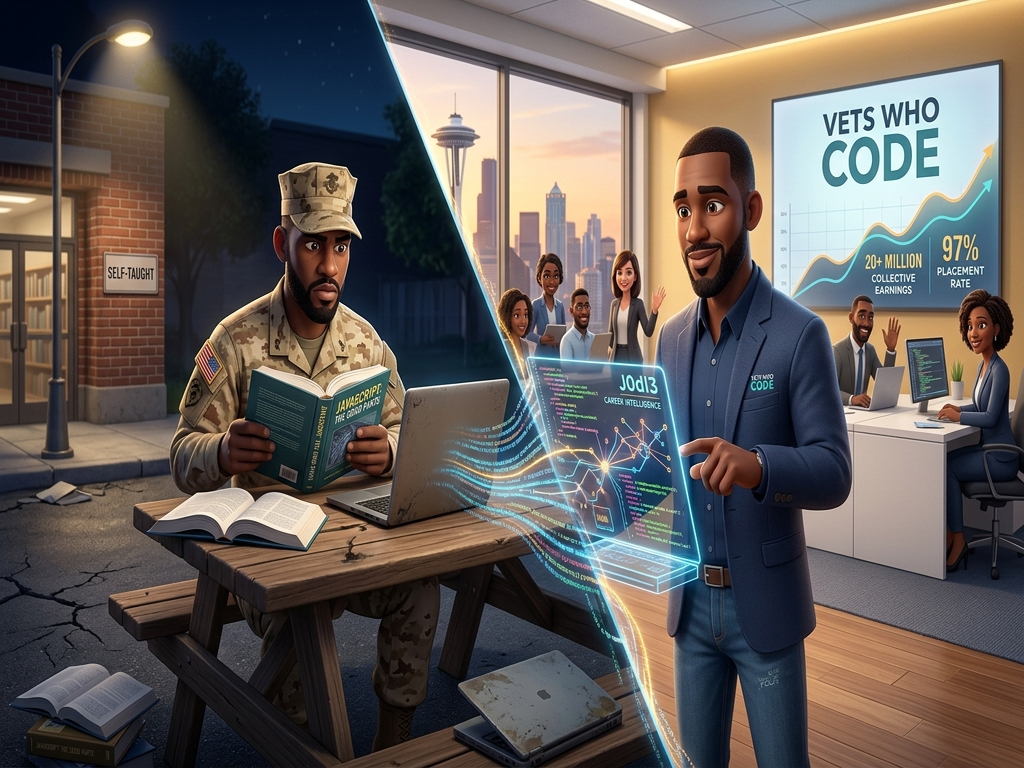
From a Barnes & Noble Coding Book to 300 Veterans in Tech: Jerome Hardaway's Vets Who Code
In 2010, Jerome Hardaway sat in a Barnes & Noble with a coding book and a chip on his shoulder. He was an Air Force veteran, out of the service, and staring at the same wall a lot of veterans hit: a résumé full of discipline, pressure, and real responsibility that civilian employers somehow read as "no experience." The job market was rough. The doors he expected to open stayed shut.
So he taught himself to code. Not in a classroom, not with a degree — with library books, free tutorials, and the kind of stubbornness the military tends to build into people. It worked. He got hired as a web developer. But the thing that stuck with him wasn't landing his own job. It was a moment a couple of years earlier, when he'd used technology to help a family raise money to bury a veteran. That was when it clicked for him: this stuff could change lives, not just pay bills. In 2014, he turned that idea into an organization and called it Vets Who Code.
Here's the part that makes people do a double-take: Vets Who Code is completely free. No tuition. No income-share agreement where they take a cut of your future paycheck. No "free trial" that turns into a bill. It's a registered nonprofit, funded by donations, and it runs entirely remote so a veteran in rural anywhere can join from a laptop. The program teaches modern web development — JavaScript, React, Git, the command line, the actual tools working engineers use every day.
But Jerome figured out something early that shaped everything: for the veterans coming through his doors, coding was rarely the hard part. The hard part was translation. "The gap isn't in capability," he's said. "It's in translation." Think about what that means. A sailor who spent six years as a Missions Manager led training for 35 people and fixed high-priority system failures under pressure. In tech terms, that's incident response and engineering management. But no recruiter reads "Missions Manager, U.S. Navy" and thinks "this person can debug production systems and lead a sprint." The skills were always there. Nobody had handed these veterans a dictionary to explain their own worth in a language employers understood.
A decade in, the results are hard to argue with. More than 300 veterans and military spouses have come through Vets Who Code. Graduates have generated over $20 million in collective earnings. The job placement rate sits at 97 percent. And they've landed at Microsoft, Amazon Web Services, Google, Home Depot, and dozens of other companies — all of it free, all of it remote, all of it built, in Jerome's words, "on donations and discipline." The people behind those numbers had ordinary starting points. A radiology technician from the Army is now a DevOps engineer at Microsoft. A flight-line mechanic who worked on aircraft electrical systems is now a professional web developer working remotely while his wife continues to serve. One graduate was an aircraft ground equipment mechanic who broke her ankle on the job, discovered she loved building things on a screen, and never looked back.
After a decade of watching hundreds of people make the exact same leap, Jerome and his team noticed patterns — patterns no generic career advice ever captured. So they built an AI system to hold onto them, and named it J0dI3. It reads a résumé, audits a person's GitHub, looks at their LinkedIn, and scores how ready they actually are for the job they're chasing. But it does it differently from the usual AI résumé checkers, and the difference is the whole point. Most AI career tools are trained on people already working in tech, then they tell everyone else to look more like those people. If you don't have "three years of React," your score drops. J0dI3 was built on the opposite data — on watching people with zero traditional background succeed anyway. It's trained to treat a "systems-adjacent" military job, like a mechanic or an intelligence analyst, as a positive signal for engineering, not a deficit to apologize for. It rewards someone with twenty real commits to a live project over someone with a computer science degree and an empty GitHub. It even knows that a first job and a breakout job need two different résumés, and it scores for where you actually are. In other words, Jerome took the hardest career change there is and taught a machine to understand it the way a mentor would — not to replace the human work, but to make sure a decade of hard-won knowledge doesn't vanish into somebody's memory.
Jerome didn't stop at running the nonprofit. Today he works as a senior AI engineer, and he teaches thousands of developers through LinkedIn Learning and Frontend Masters. He's a Google Developer Expert. The self-taught guy from the Barnes & Noble is now one of the people other engineers learn from. But ask him what matters and he keeps coming back to the veterans. One graduate, a small-arms repair technician for ten years across the Marines and Army National Guard, became a senior software engineer. When asked what mattered most for career changers, he didn't say "learn React." He said planning and problem-solving — because languages come and go, but the ability to break a huge problem into pieces you can actually solve lasts forever.
Jerome's story is the whole thesis of AI Bridge Foundation in one person. He didn't have money, a degree, or connections. He had grit and access to free tools, and he turned that into a career — and then he spent ten years building the doorway for other people to walk through the same way. Free. Remote. Open to the people the industry usually overlooks. And notice how AI shows up in his story. Not as a magic shortcut, not as a threat, but as a way to bottle up human wisdom and hand it to the next person in line. That's the version of AI we believe in: a tool that amplifies people instead of replacing them, especially the people who've been told their whole lives that they don't belong in the room. Jerome belonged. He built the room. And the next 300 are already on their way in.