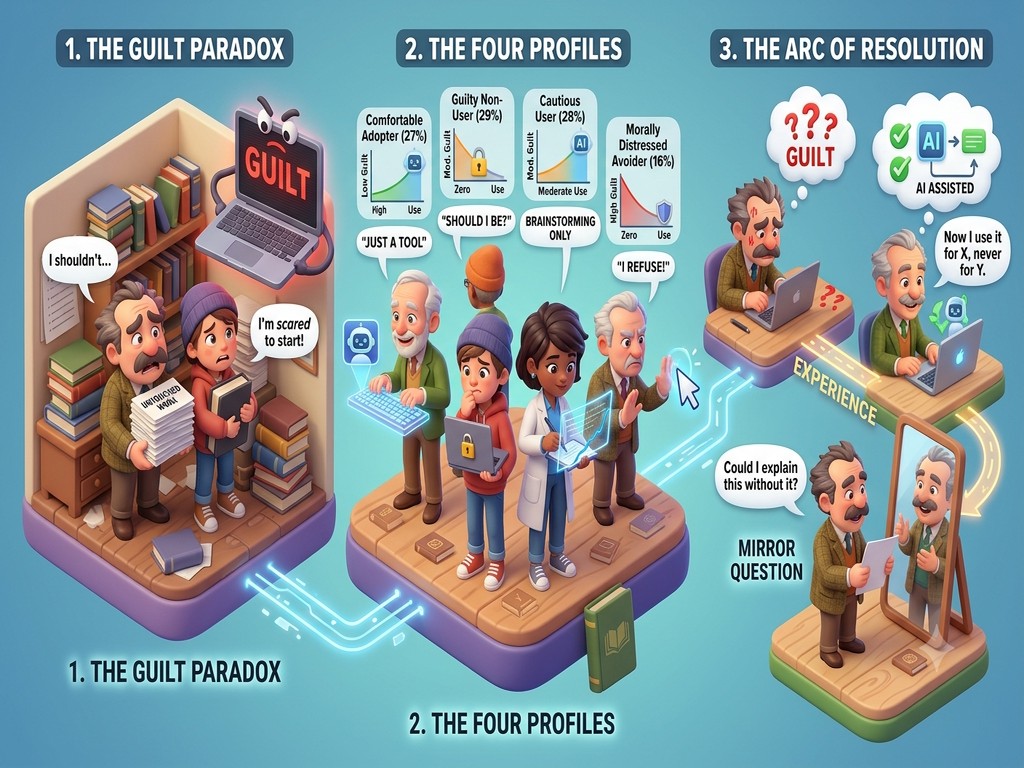
AI Guilt Is Real — And It’s Not About Cheating
Here's a strange finding: people who don't use AI feel guiltier about it than people who do.
That's not a typo. A 2026 study of 109 academics found that the group experiencing the most moral distress about AI wasn't the heavy users — it was the people avoiding it entirely. They scored higher on every guilt measure. They worried more about credibility, more about cheating, more about losing their edge. The people who actually used AI? Most of them had worked through those feelings months ago.
Researchers call this the guilt paradox. And if you've ever hovered over ChatGPT feeling like you're about to do something wrong — or felt a weird shame for not using it when everyone else seems to be — you've already lived it.
It's Not About Cheating
When people say "AI guilt," most assume it's about getting caught. Plagiarism. Cutting corners. But that's not what the research shows.
A validated instrument measuring AI guilt in students identified three dimensions, and none of them are "fear of punishment":
- Perceived laziness — "Am I becoming the kind of person who can't do things on their own?"
- Fear of judgment — "If people knew I used AI for this, would they think less of me?"
- Identity and self-efficacy — "Is this still MY work? Am I losing the ability to think?"
That third one is the deepest cut. It's not about rules. It's about who you believe you are.
A college student acing their essay with AI assistance and then bombing the in-class exam isn't just a grade problem — it's a mirror. The 26,000-student study that went viral this month found exactly this pattern: homework scores up 18%, exam scores down 20%. The AI did the remembering for them, and their brains never encoded it.
But here's the thing — the guilt people feel about AI isn't usually about that situation. It's about the ambiguity. Your school says "AI is fine as a tool." Your professor's tone says otherwise. Your classmates all use it. Nobody talks about it openly. You're left drawing your own ethical lines in the dark, then feeling terrible no matter where you draw them.
The Four Types of AI Guilt
That same 2026 study found that people don't experience AI guilt the same way. They sorted into four distinct profiles:
Comfortable Adopters (27%) — Low guilt, high use. They framed AI as "just a tool, like a calculator" early on, and moved on. They tend to be senior in their careers, with established reputations that feel less threatened.
Guilty Non-Users (29%) — The largest group. Moderate guilt paired with avoidance. They know AI exists, suspect they should be using it, but the anxiety of starting keeps them frozen. Their guilt is anticipatory — about something they haven't even done yet.
Cautious Users (28%) — Moderate use with personal rules. "I'll use it for brainstorming, never for final drafts." They've negotiated their own boundaries and mostly feel okay — until someone challenges those boundaries.
Morally Distressed Avoiders (16%) — High guilt, near-zero use. AI feels like a fundamental threat to their identity. One academic in this group said: "I refuse to use AI. I won't let my thinking be influenced by what is created by a machine."
Notice something? Only one of those four groups is actually comfortable. The other three are stuck in some version of moral limbo.
Why It Gets Worse Before It Gets Better
The research revealed one more pattern that matters: guilt follows a timeline. It's worst at the beginning — before you've actually used AI enough to know what it can and can't do. The anticipation is worse than the reality.
People who pushed through initial discomfort described a consistent arc: intense guilt at first, gradual realization that AI doesn't replace their thinking (it's more like a rough draft machine), and eventual comfort with clear personal boundaries.
The problem? If you never push through that initial discomfort, you never reach the other side. The non-users stay anxious. The avoiders stay morally distressed. Fear of the transgression prevents the experience that would resolve the fear.
A Framework That Actually Helps
If AI guilt resonates with you — whether you're a student, a working professional, or someone who just asked ChatGPT to help with an email and felt weird about it — here's what the research suggests actually works:
Name it. The guilt isn't a sign you're doing something wrong. It's a sign you care about doing things right. That's worth recognizing.
Draw your own line — out loud. The people who felt best about their AI use had explicit personal rules. Not "I'll figure it out each time," but "I use AI for X, never for Y, and here's why." Write it down if you need to.
Test the fear. If you're avoiding AI because of what might happen to your thinking, try a 30-day experiment. Use it for one specific task. See if the fear matches reality.
Ask the mirror question. Before submitting any AI-assisted work, ask: "Could I explain this to someone without the AI? Could I redo it from scratch if asked?" If yes — it's still yours.
Talk about it. The study found a strong link between guilt and secrecy. The more people hid their AI use, the worse they felt. The simple act of saying "I used AI for the outline, then wrote the rest myself" disarms the shame.
The Real Question
AI guilt isn't going away. The tools are only getting better, the lines are only getting blurrier, and schools and workplaces are still figuring out their own rules.
But the guilt itself isn't the enemy. It's a signal that you're thinking about this — that you haven't just outsourced your judgment along with your first draft. The people who never feel any friction about AI use might be the ones who should worry most.
The goal isn't to eliminate the discomfort. It's to move through it honestly, with boundaries that match your values — and to stop punishing yourself for using a tool that everyone around you is also quietly figuring out.